
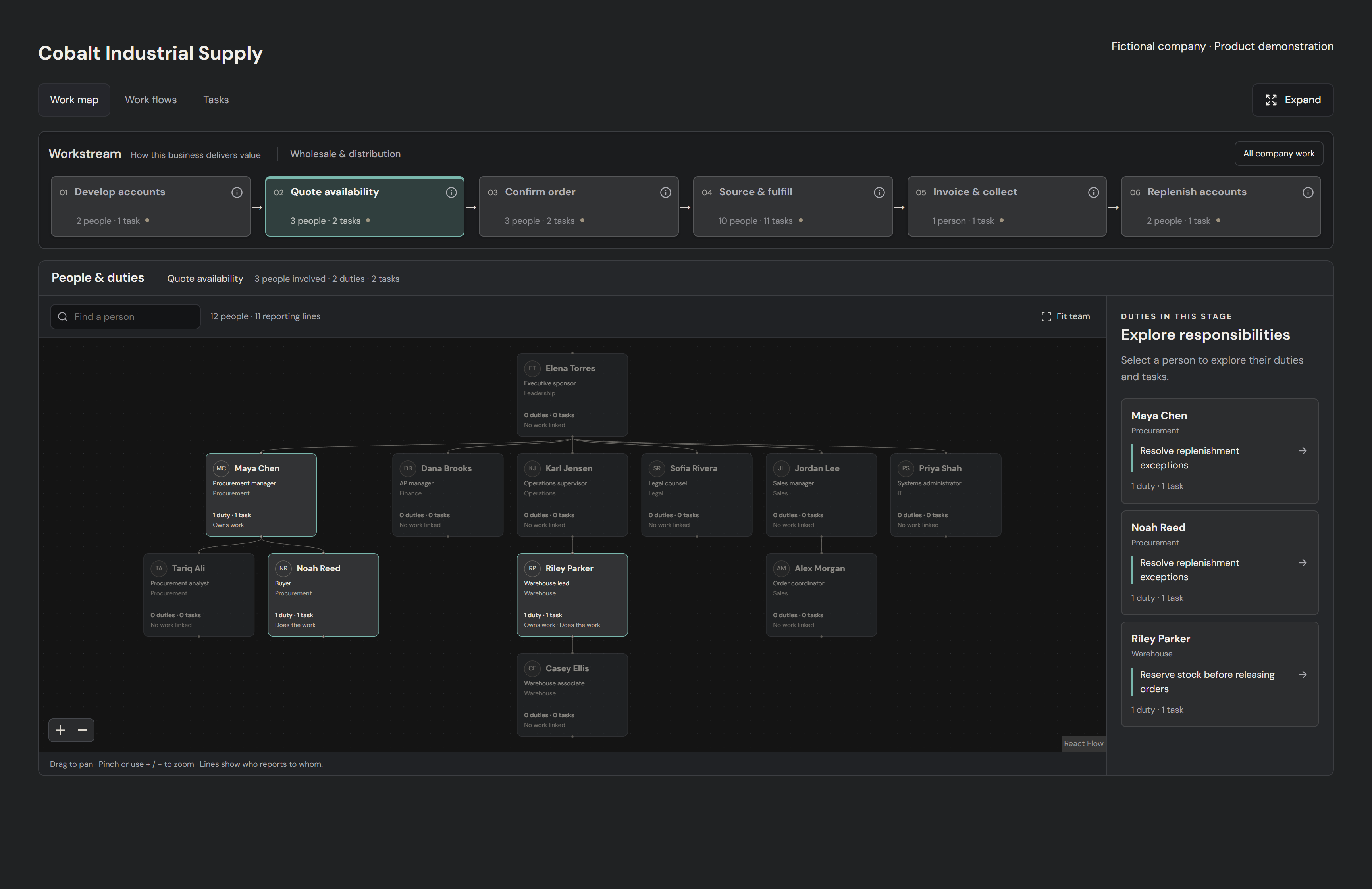
A missed handoff, a decision waiting on the owner, or a spreadsheet only one person understands can make a capable team feel permanently behind. An operations audit should help you understand the work beneath those symptoms before you commit to another system or another reorganization.
DutyGraph supports an advisor-led review of people, duties, tasks, software and handoffs. For a smaller company, start with the whole business. For a large organization, agree which departments to review first. Hear from leadership and the people doing the work. Build a reviewed picture of what is happening, what remains uncertain and what deserves attention next.
Current availability: DutyGraph is in an advisor-pilot stage. Scope, participants, fees, timing and data-handling terms are agreed before an engagement begins. An inquiry does not book an audit or commit you to implementation.
What is a business operations audit?
Here, a business operations audit means a structured review of how your business actually operates. It examines what starts the work, who performs it, what information they need, where it changes hands and how the result is checked.
It is not a financial statement audit, tax review, legal opinion or compliance certification. It is also not a promise to find a predetermined amount of savings.
Start with the problem you can recognize
You do not need a finished process diagram. Bring a situation such as:
- Customer commitments keep getting lost between sales and delivery.
- Routine exceptions come back to the owner because nobody knows who can decide.
- A critical process depends on one experienced employee.
- Teams re-enter the same information in different systems.
- Leadership wants to use AI but cannot identify a sensible first task.
Start by understanding the business and its main areas of work. Then use concrete examples, such as an accepted quote becoming an order, to investigate the details. For a large organization, agree the departments to include first.
How the review works
Establish the business context. An advisor works with leadership to clarify the goal, value-creating stages, participants and known responsibilities. Leadership's description is a starting hypothesis, not a substitute for employee evidence.
Hear from the team. Participants receive private, role-specific requests. They explain their work by voice or text and review the task descriptions drawn from their response. They do not have to write a polished procedure before contributing.
Reconcile the differences. The advisor compares accounts, follows up on unclear ownership and separates reported work from approved policy. Live conversations remain available when a disagreement or sensitive issue needs them.
Choose the next decision. The readout should distinguish findings, open questions and proposed improvements. Sometimes the next step is a process change. Sometimes it is better documentation, clearer responsibility, integration or a bounded AI experiment.
See the DutyGraph discovery method.
What to agree as deliverables
A scoped audit can work toward a current-state work map, linked people and task records, a list of unresolved handoffs or responsibilities, and a prioritized next-step brief. Agree the exact outputs in the engagement scope.
Ask for the evidence behind each finding. A reported delay is not yet a measured delay. A proposed saving is not realized value. Where supporting records are unavailable, the brief should say what still needs to be collected.
For a preview of the questions, use the business operations audit checklist.
A practical example
Illustrative, not a customer result: Sales says an order is ready once the quote is accepted. Operations says it cannot begin until delivery details and the approved configuration arrive. Finance is waiting for the customer's billing information. Everyone completed their local step, but the handoff has no shared acceptance rule.
The useful finding is not “the team needs more automation.” It is that “ready” means different things to three teams. The next action is to agree the required information and the receiving owner, then measure whether rework declines.
Include an AI opportunity review when it is useful
An operations audit can also surface tasks that may deserve an AI or automation experiment. The question is not simply whether a task is repetitive. A useful candidate also has a clear purpose, reliable inputs, an identifiable owner, reviewable outputs, manageable exceptions and a human checkpoint where judgment still matters.
DutyGraph treats that as part of the operating review rather than assuming every audit must end in an AI project. The next action may be clearer responsibility, better process documentation, a system integration, a conventional automation or a bounded AI pilot.
Which assessment do you need?
Choose process mapping services when your immediate need is a detailed current-state workflow. Use the AI opportunity review in this audit when you need to compare candidate tasks before selecting tools. An AI readiness assessment asks whether a chosen use case has the operating conditions needed for a responsible pilot.
What affects cost and timing?
The main scoping factors are workflow boundaries, participant count, business units involved, available evidence, sensitivity of the information and the amount of reconciliation required. We agree fees and timing after scoping; there is no guaranteed turnaround on this page.
Start with your company
Tell us what feels slow, unclear or dependent on a few people. We will use the initial conversation to determine whether an advisor-led DutyGraph pilot is appropriate.