
A box labeled “operations handles it” is not enough to improve a process. You need to know what arrives, who acts, which decisions change the path and what the next team needs before it can begin.
DutyGraph supports advisor-led process discovery and mapping using leadership context, employee accounts and supporting evidence. If you are comparing process mapping consultants, the important question is not who can draw the cleanest flowchart. It is who can establish what the team actually does, where accounts disagree and which handoffs need evidence. The aim is a reviewable description of work, not an attractive diagram that nobody can verify.
Discuss a process-mapping engagement
Process discovery comes before the finished map
Discovery gathers the evidence. Mapping organizes it into a usable representation. A diagram may include actions, inputs, outputs, decisions, people and measures; ASQ describes these as common elements of a process flowchart. ASQ: Flowchart
For DutyGraph, a useful task record also connects the work to its duty, purpose, systems and human checkpoints. A workflow can cross departments. The organizational chart and the workflow map answer different questions.
What we need from your team
Begin with a sponsor, a workflow owner and the people who send, perform, review or receive the work. Agree the boundaries and the information that may be collected. Existing SOPs, sample forms and approved system records can help, but having incomplete documentation is not a reason to invent the missing steps.
Leadership establishes the context. Each participant can then respond to a private request by voice or text. The advisor reviews the accounts together and follows up where they do not agree. The process discovery interview guide shows the kinds of questions that make those responses useful.
What the map should make visible
A scoped engagement should establish which of these outputs matter:
- The normal path from trigger to accepted result.
- Task owners and performers, including uncertain or disputed ownership.
- Required inputs, systems and handoff conditions.
- Exceptions, decisions and human review points.
- Sources supporting the map and questions that remain unresolved.
A current-state map describes what the team reports doing now. A future-state proposal describes a change they may choose to make. Keep them separate so a proposed improvement is not mistaken for an existing process.
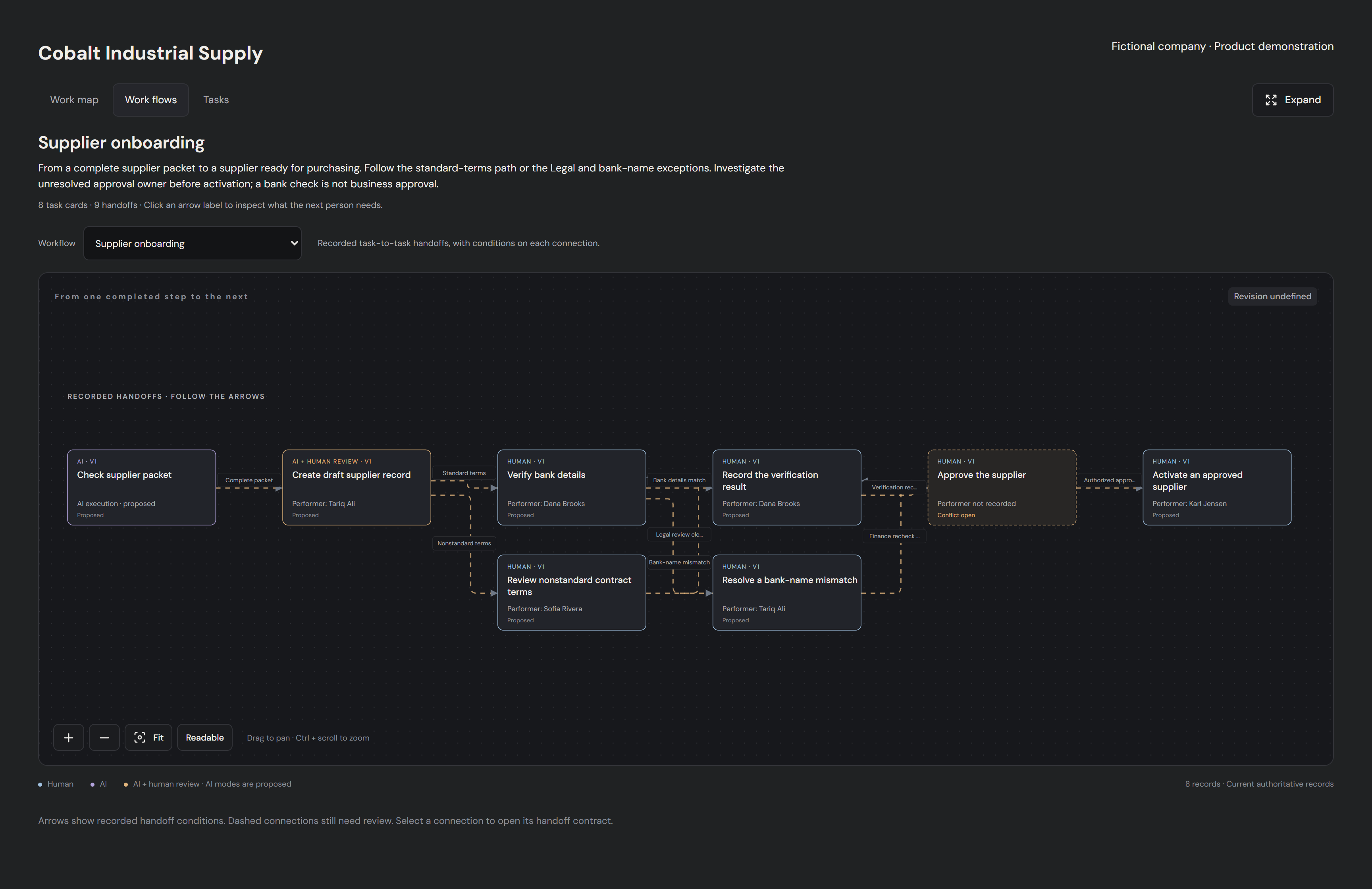
Example: supplier onboarding
Illustrative workflow: A purchasing employee collects supplier information. Finance checks billing details. A manager decides whether the supplier can be used. Someone creates the record in the business system.
A useful map asks what happens when the legal name differs from the bank information, who may resolve the difference and whether an employee is describing a current rule or a workaround. It records that explanation without automatically granting permission to approve a supplier.
The cross-functional handoff guide explains how to test whether the next person can actually start work with what they receive.
Not every problem needs a new platform
A mapping exercise may suggest clearer intake, a responsibility decision, a better system connection or additional measurement. It may also identify a bounded task worth testing with AI. The mapping work should not assume automation is the answer before the workflow is understood.
If the main decision is what to improve, start with the business operations audit. If a workflow is already understood and you need to evaluate candidate automation, explore the AI opportunity assessment.
Will this require interviewing everyone live?
Not necessarily. DutyGraph's private voice and text requests let participants contribute on their own schedules. That changes how evidence can be collected, but it does not eliminate follow-up or replace direct observation when the work requires it. Actual effort and turnaround remain pilot measurements, not established claims.
Can we use this instead of process mining?
Sometimes the starting evidence is people and documents; sometimes it is system activity. These methods can complement one another. Read process discovery, process mining and task mining compared before selecting a method.
Agree one useful deliverable first
DutyGraph is currently offered through scoped advisor-pilot engagements. Bring a workflow, the decision the map should support and the people who can help validate it. We will discuss fit, evidence, timing and fees before work starts.