
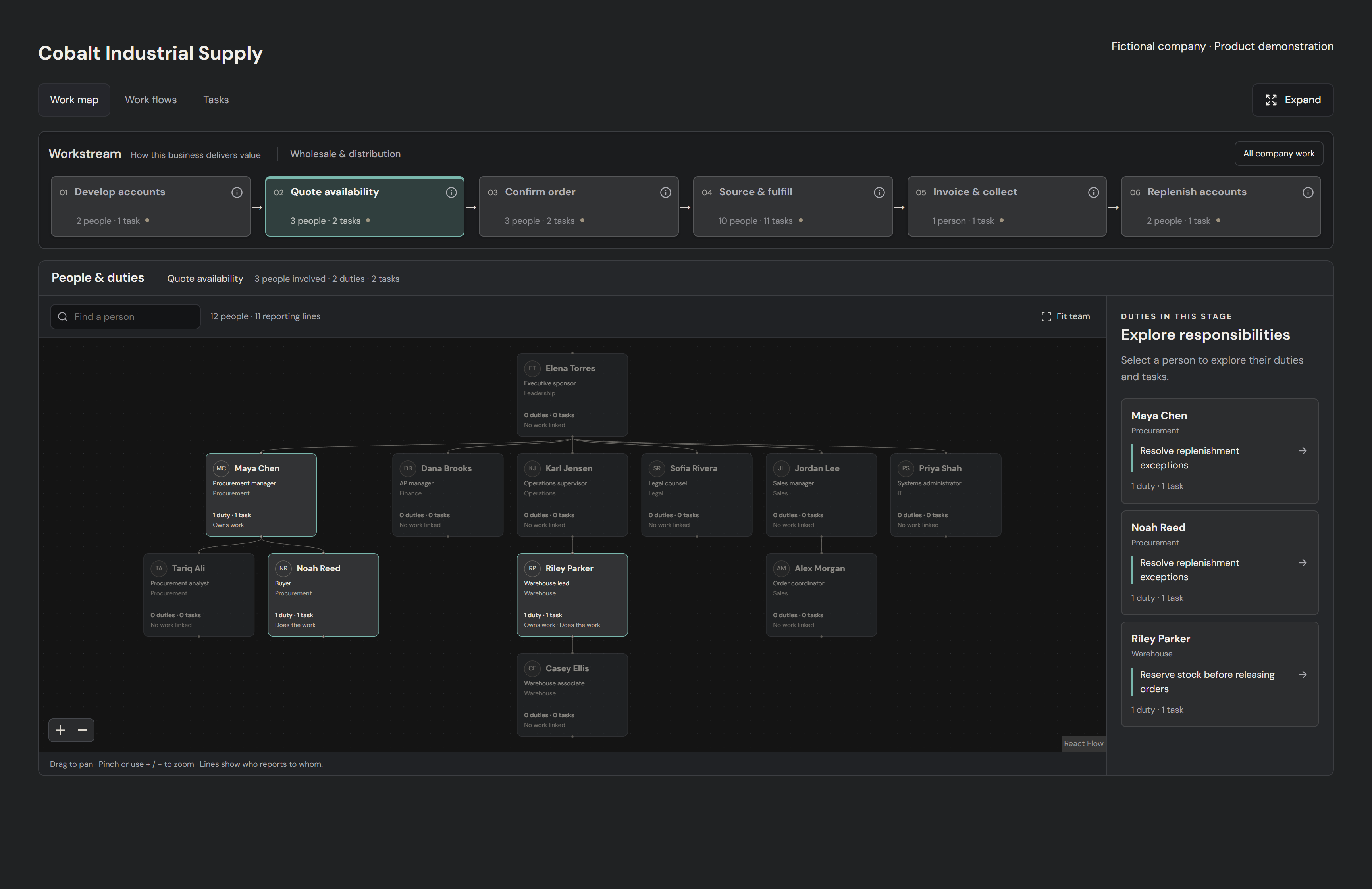
Your business does not need to be “AI-ready” in every department before making one useful improvement. It needs a well-defined use case and a realistic view of the conditions required to test it.
DutyGraph supports an advisor-led readiness conversation about the work itself: who owns it, what information is available, which systems it touches, what can go wrong and who will review the result.
Request a readiness conversation
A readiness assessment is not a certificate
For this offering, readiness means examining the prerequisites for a scoped AI pilot. The same framework works for a small or midsize business that wants a practical AI readiness assessment without pretending the entire company can be reduced to one score. It does not establish legal compliance, approve system access or certify an organization as safe for autonomous operations.
A free quiz may help start a discussion. It cannot, by itself, verify the workflow, inspect the input data or establish who can authorize a change. DutyGraph's proposed assessment goes deeper through leadership context, participant accounts and evidence review.
Five questions worth answering
Is the task clear? Identify the trigger, input, action and expected result. “Help operations” is not specific enough to test.
Is the information usable? Establish where the input comes from, whether it is accessible for the proposed use and what happens when it is incomplete or inconsistent.
Is there a responsible owner? Name the person who can decide whether the pilot is useful and the person who checks the output. Performing a task and authorizing a change are different responsibilities.
Are the boundaries explicit? Decide what the pilot may draft, suggest or change, and what must remain outside its scope. A task description does not grant credentials or permission.
Can the result be evaluated? Select an appropriate baseline and a review method. Record important errors, review effort and downstream effects, not only the time taken to generate an answer.
Why begin with team discovery?
A manager may believe a task is predictable. The employee doing it may explain that a small group of customers always follows a different route. That exception can change the pilot's scope, the required data and the human checkpoint.
DutyGraph uses private, context-aware discovery to help surface those details. The accounts still need review; an AI-generated task card is not a verified description merely because its fields are filled in.
Example: an internal request assistant
Illustrative scenario: An operations team wants AI to summarize incoming requests. A limited pilot might draft a summary while a person chooses the response. Readiness questions include what request data can be processed, how unclear requests are flagged, how corrections are recorded and whether the pilot is kept out of approval decisions.
That team might be ready to test summarization without being ready to let an agent approve purchases or change a customer record.
What the assessment should produce
Agree a use-case brief, a list of prerequisites and gaps, explicit human review boundaries and a proposed next decision: test, narrow the scope, improve the inputs or defer. Where specialist security, legal or technical review is required, identify that dependency rather than treating a business assessment as a substitute.
If you are still choosing which tasks to examine, begin with the AI opportunity review inside the business operations audit. If the workflow itself is not understood, use process mapping services.
What about AI governance readiness?
Business-use-case readiness and governance readiness overlap, but they are not interchangeable. Our existing AI governance readiness checklist discusses the broader ownership and control questions. This page focuses on the operating conditions of a particular task.
Start with one task worth evaluating
DutyGraph is in an advisor-pilot stage. Fees, scope, timing, providers and data-handling terms are agreed before work begins. Bring one workflow and the decision your team needs to make next.